Once or twice a year, I get an email that makes me laugh every single time. The first line is one word: "Shibboleet." Then a completely normal message follows underneath, from a friend or a family member, like nothing strange just happened:
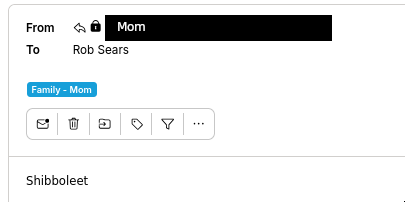
That one word is the last surviving artifact of my attempt to escape fifteen years of Gmail. Moving to a new email provider took an afternoon, but re-training the humans who still had my old address memorized took much longer.
When Rob Met Google🔗
When Google launched Gmail in 2004, I was a college sophomore still using a free Yahoo! account I'd set up as a high school freshman. My university offered email too, but it was old, slow, and gave you something like 5MB of storage (yes, 5 MB, not a typo).
Two problems, specifically. First, 14-year-old me picked a regrettable handle that 20-year-old me was stuck with while looking for internships. Second, my Yahoo account topped out at 6MB, and (because Dropbox didn't exist) I'd taken to backing up schoolwork by saving it as email drafts, which filled the quota fast. Yahoo's ad-crammed UI didn't help either.
Gmail solved both of these for me at launch: I landed an invite early, got a more professional handle, and started with a mailbox 150x the size of what I'd had before. And the inbox allowance kept growing. It was cleaner and easy on the eyes. I imported my entire Yahoo archive without making a dent in the quota. Life was good. Yay for Google. 🎉
Fifteen Years is a Long Time🔗
Fifteen years later, Google's tendrils are found in every corner of the web. Chrome and Android both phone home. They track you even when you tell them not to. Post a picture of your car online and Google's probably indexed your license plate; post a picture of your guns and it'll index the serial numbers too. I was especially unsettled by Eric Schmidt's authoritarian take on privacy, Google's role in PRISM, and the quiet reversal of their ban on tying PII to web tracking.
Moreover, an email provider has an extraordinary window into your life: who you talk to, what you buy, what you're worried about. Google specifically can cross-reference against your search history, your location, your YouTube habits, and more. You're entrusting the full shape of your life to a single for-profit company, on the strength of a motto they've since quietly dropped.
Like a lot of tech nerds, I use the usual stack of ad blockers and sandboxing, but increasingly I suspect this isn't enough. So one afternoon, a few beers deep watching a disappointing Husker loss, I parted ways with Gmail.

How Hard Could It Be?🔗
My first instinct was to cut Google out entirely: spin up my own mail server on EC2 or Linode, run my own MTA, own the whole stack.
I talked myself out of that shit fast. Running your own mail server is notoriously unforgiving. One misconfigured header or a reputation ding against your IP and you're hand-debugging SPF records while your mail silently vanishes into other people's spam folders. It would've been a second job, but unpaid, running a production service, except the failure mode wasn't "the app is down," it was "my email has been quietly leaking to whoever can read an unencrypted inbox on a box I'm patching at 11pm." Trading Google for that risk profile felt like a bad deal. Possibly a worse one, since at least Google has a security team.
The harder question was the non-technical one: after fifteen years of building a digital identity on top of one company's infrastructure, was I actually capable of leaving? Replacing a search engine is trivial. Replacing an email address means replacing something every bank, mailing list, old coworker, and two-factor prompt in your life has memorized.
I've been in the tech space for a long time, and somehow I keep re-learning that the human factor is the hardest thing to plan for.
A Home In the Alps🔗
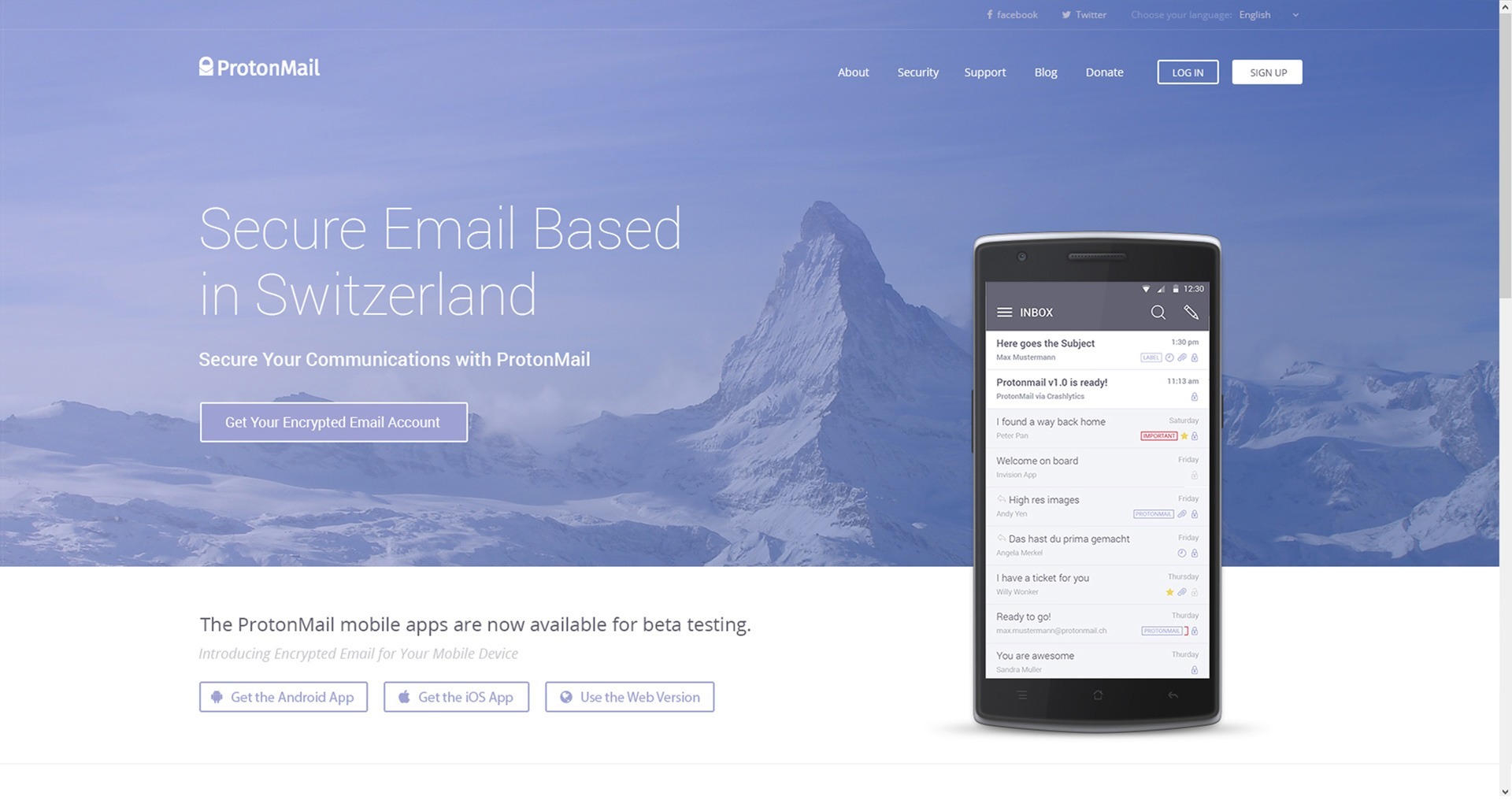
I landed on ProtonMail as the Gmail replacement. It's feature-rich, has a decent iOS app, and messages between Proton users are end-to-end encrypted. If both Proton users have taken the step of passphrase-protecting their private key, then Proton genuinely can't hand over those messages in plaintext form even if a government leans on them.
That's the philosophical antithesis of Google's "collect everything, trust us" model. That said, mail to and from non-Proton addresses (really, most of my mail) isn't E2E encrypted, and Proton does know, by necessity, where my messages are coming from and going to.
Simply, Proton does not offer an escape from trust altogether. If they really wanted to, they could do some less sophisticated Google-lite profiling on me and provide it to 3rd parties. The difference is that sort of thing is not part of their revenue model, never has been, and they're headquartered in a nation known for strong privacy laws. I just trust them more than Google.
ProtonMail is free at the entry tier; I paid for a plan with more features, which runs less than a Netflix subscription. I pointed my domain's MX records at Proton so I could keep using rob@[this domain], and picked up a cheap throwaway domain configured as a catch-all to use for site registrations going forward.
The Easy Part: GTFO Gmail🔗
The data migration was almost anticlimactic. I pulled my email archives from Google Takeout as .mbox files, confirmed Thunderbird could import them cleanly, and left it at that. I rarely need anything older than a few weeks, so I didn't bother importing the archive into Proton itself and polluting a clean inbox with 15 years of cruft. Contacts uploaded without any drama.
A stupid trick that simplified this further was having salted emails. My archives already had a record of exactly who'd been emailing which variant of my address, and how often:
cat *.mbox | egrep '^Delivered-To:.*?\+' | sed -E 's/.*: (.*)/\1/' | sort | uniq -c | sort -nrThat one-liner turned fifteen years of inbox chaos into a ranked list of who actually mattered: the services worth manually updating, in order of how much I'd miss them if I didn't.
An afternoon, start to finish. If that had been the whole migration, there'd be nothing to write about.
The Hard Part: Everybody Else🔗
My email address was so old that friends and family had it memorized since before smartphones existed. Sadly the MX records in their brains can't be updated so easily. There's no frequency-sorted list of "people who might email you sometime in the next decade."
I could collect a list of everyone that had ever emailed me and send them an email about my new address. For one, that would involve a fair amount of work to review + prune the list (after all, I've been messaged by people I don't care to hear from again, and I don't want to re-initiate contact). And two, mass-emailing whoever is left can be a problem. An email-per-person would be tedious and may get my email flagged for abuse, whereas a big BCC list can easily result in the message ending up mostly in spam folders. The Two Generals Problem strikes again!
After thinking on it for a while, I realized that I could just set up a permanent vacation autoresponder on the old Gmail account. Everyone who emails the old address gets a reply explaining the account is no longer monitored, and that to reach me they'd need to reply with a special codeword. Pair that with a filter that forwards anything containing the codeword to my new ProtonMail address, and boom: you've got a challenge-response system!
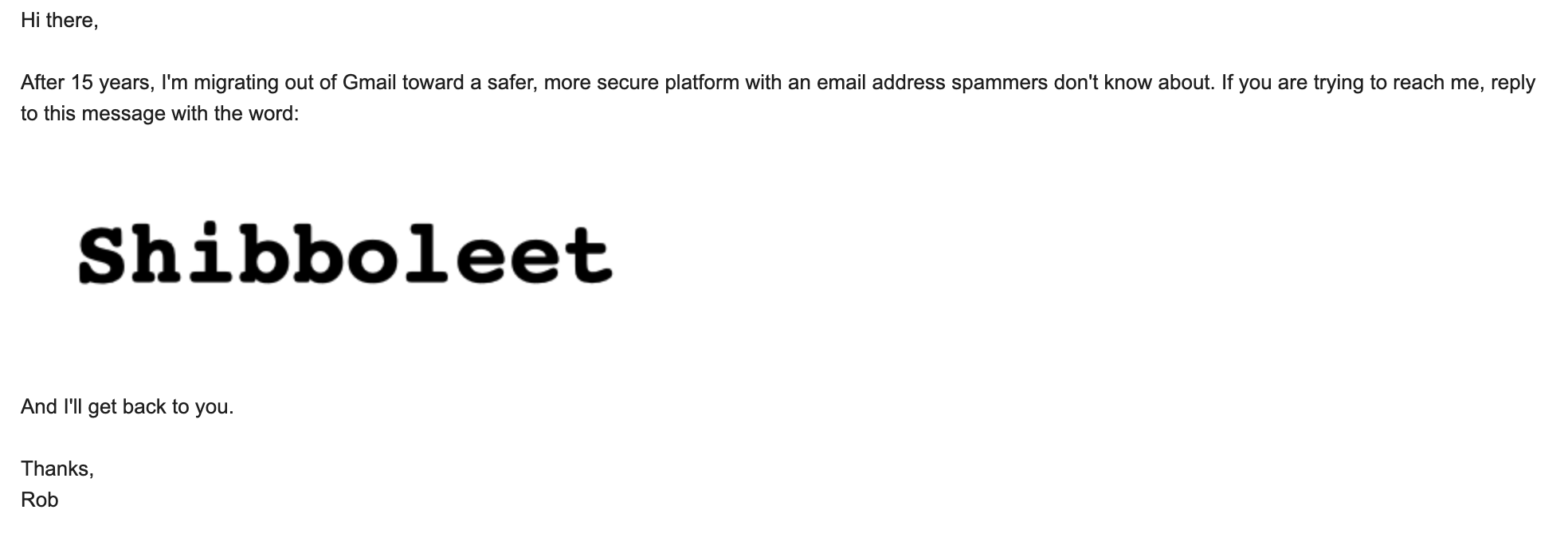
I embedded the codeword in an image rather than plain text, so automated replies quoting my original message wouldn't accidentally trigger the forwarding filter. Sure, a spammer could use OCR to extract the word, but why bother? The economics of spam depend on sending enormous amounts of email with practically zero effort per recipient. I figured nobody was going to spend additional resources reading auto-replies for this exact thing just to ensure I received their ad for boner pills.
The result is a remarkably effective filter for people who actually wanted to reach me. Spam, mailing lists, and automated notices never make it past my abandoned inbox.
So, Did It Work?🔗
Two years on: yes, well enough that I mostly forget it's still running.
I check the old Gmail inbox periodically out of habit. It's never been anything but mass mail, ads, spam and phishing attempts. Family and friends who still had the old address have, every one of them, eventually replied with the codeword, and it's been forwarded to ProtonMail without a hitch. It's happening less and less now, which is exactly the point.
The honest costs are on the ProtonMail side, not the migration side. It's not free at the tier I wanted ($8/month), the inbox is smaller than Gmail's (5GB, with a billing system for extra storage that makes you add a whole second "user" to unlock more space -- don't ask), and you need a bridge app installed to use a traditional client like Thunderbird or Outlook. There's also no clean, first-party way to export your mail back out, which is a little uncomfortable for someone who just spent months thinking about vendor lock-in. But I'll get to that at some point.
You Can Check In, But You Can't Check Out🔗
The obvious irony in all this being that my grand escape from Google's infrastructure... still depends on Google's infrastructure. Or at least it did for a long time. The more time goes by, the less it matters whether Google shuts down that old account. Someone who hasn't emailed me in two years probably won't email me in three, five, ten, or... ever.
Something I hadn't appreciated until then was that an email address creates social lock-in as much as vendor lock-in. What keeps people using a free service like Gmail isn't necessarily the technical challenge of moving to another host. It's the threat of people they want to hear from no longer being able to reach them.
Being unable to fully divest from Google in an afternoon was the price I paid for accumulating so many years of using an email address I didn't really own so much as borrow from Eric and Sergey. I suspect the most meaningful move I made in this project wasn't switching to ProtonMail at all. It was setting up the MX records for a domain I do own. Now, if Proton ever pisses me off, I can evacuate elsewhere and take my email address with me. No need to have another challenge-response.
So I didn't achieve complete independence, at least not right away. I achieved something considerably less glamorous: the ability to change my mind without becoming unreachable.
And once or twice a year, my mother reminds me that the transition remains a work in progress.
Shibboleet.